The short version
Five things worth knowing before a roofer stands in your driveway
If you read nothing else here, read these. None of the five is a sales point and two of them are inconvenient for Keys Roofing.
- A gutter is sized to the plan area of the roof, not to the slope. Rain falls vertically. A steep roof and a shallow roof with the same footprint collect the same volume of water out of the same storm. What pitch changes is how fast that volume gets to the eave, and that is precisely why big steep planes overshoot.
- Missouri does not licence roofers. There is no state licence to check, because there is no state licence. Three separate attempts to create one died in the legislature. Anyone quoting you a state roofing licence is quoting something that does not exist.
- Decking is the line item that moves. On any house built before sheet goods became standard, the proposal contains an allowance for replacing bad decking, and that allowance is an estimate until the shingles come off. A bid with no decking line is not cheaper. It is incomplete.
- Hail counts are counts of reports. NOAA logged 125 hail events in St. Louis County between 2020 and 2025, largest measured stone 2.5 inches, average 1.32 inches. That is a record of what got reported, not of what got damaged, and reporting density tracks population.
- No roofing contractor is registered at a Creve Coeur address. Not one appears in the rated business data for this metro. That is worth explaining rather than working around, and it is why this site publishes no ranking of local roofers.
The catchment
How much water is actually coming off the roof
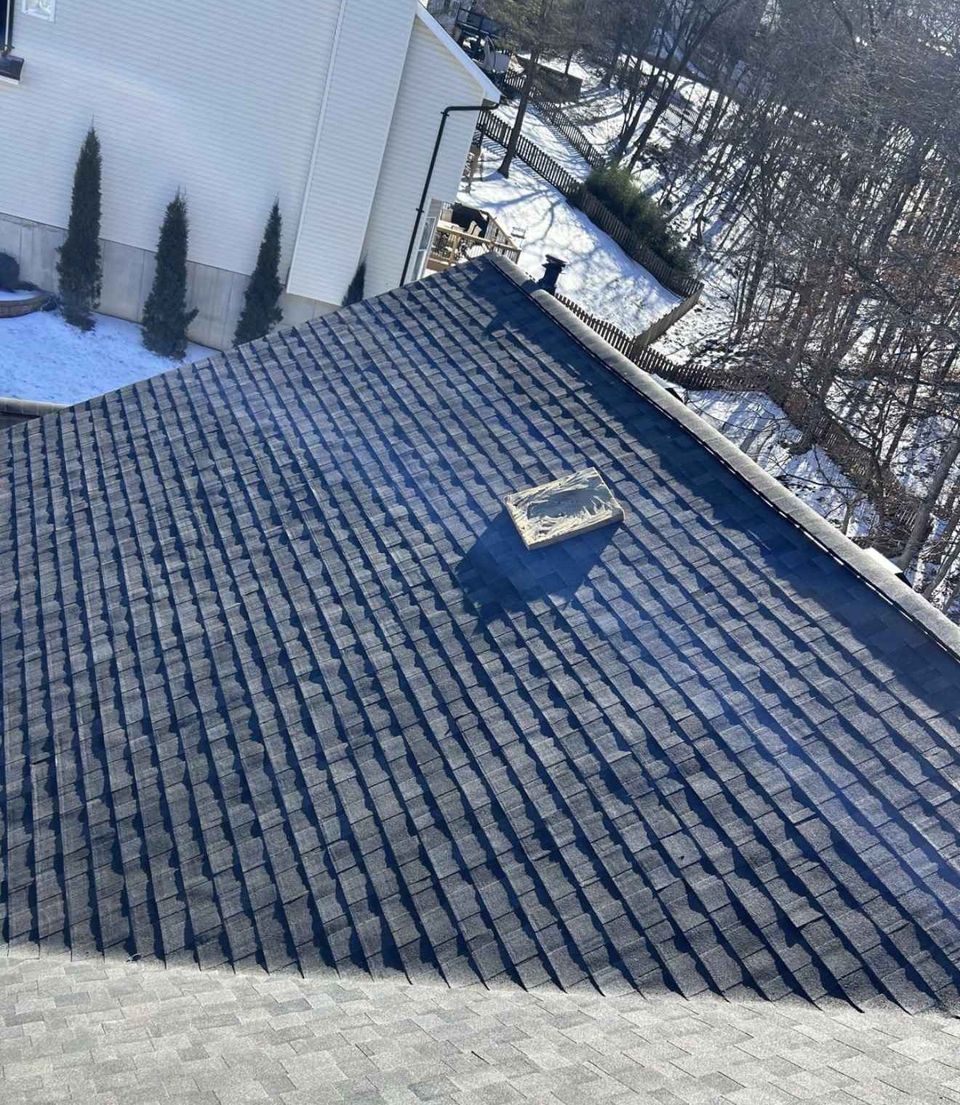
The number that matters is the footprint, the area of the roof measured flat on a plan as though you were looking straight down at it. That is the area the sky is pouring into. Multiply it by the depth of the rainfall and you have a volume, and volume is the only honest way to think about a gutter.
Here is the whole calculation, with nothing hidden in it.
Reckoning 01 · one inch of rain
A 2,600 square foot footprint is an unremarkable two storey house in this town, not a large one. That water weighs a little over six and a half tons, and in a storm that drops the inch in forty minutes it all has to leave through your downspouts inside forty minutes.
Now hold the footprint still and change the pitch. This is where most of the confusion in this trade lives, so it is worth being blunt: pitch changes the price of the shingles and it does not change the volume of the water.
What pitch does change is the speed. Water running down a 10:12 plane arrives at the eave with real momentum, and momentum is what carries it over the front lip of the gutter rather than into it. This is why homeowners on steep roofs are told for years that their gutters need cleaning again, when the gutter is clean and simply too small or too poorly outletted for what is arriving.
The full working, including the pitch multipliers and what they do to a materials order, is on the catchment sheet.
The canopy
What a mature lot puts into the drainage
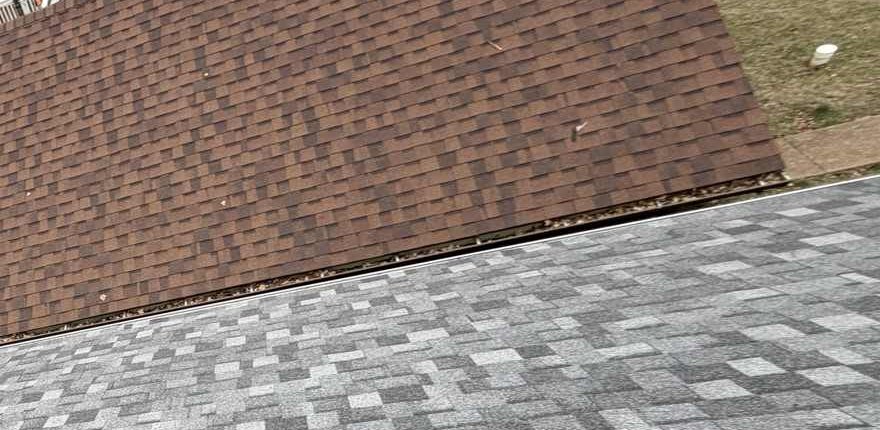
The oak and hickory that make this town what it is drop three separate loads a year onto the roof, and each behaves differently. Spring brings catkins and seed, which are small enough to pass a guard and fine enough to pack a downspout elbow. Summer brings twigs and small deadwood after every storm. Autumn brings the leaf itself, which does not so much clog a gutter as compost in it.
The compost is the part people underestimate. Leaf litter that sits in a gutter through a wet winter becomes a wet organic mass that holds water against the back of the gutter, against the fascia and against the bottom course of shingle. That is a rot mechanism, and it is slow enough that nobody connects it to the tree.
Guards help. Guards are also oversold, and no guard on the market keeps a gutter permanently clean on a lot like this. What a good guard does is convert a blockage problem into a surface problem: the debris ends up on the lid instead of inside the trough, where it is still there, and where in a hard rain it can sheet water straight over the edge. Read the canopy sheet before you buy one.

Where roofs fail
Details and decking, not the shingle field
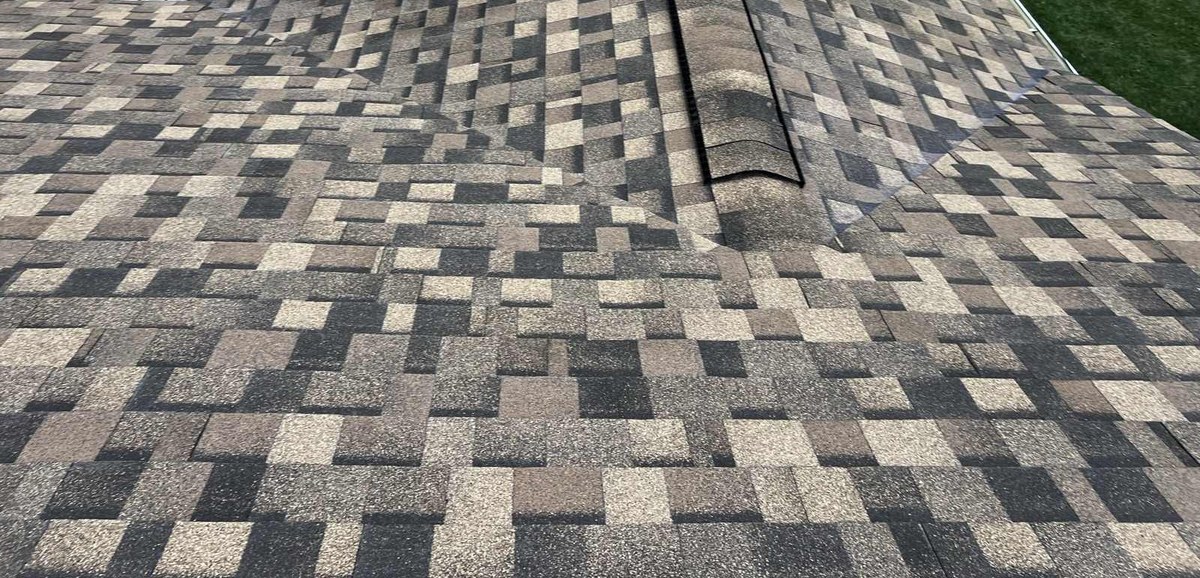
Walk a roof of this vintage and the same short list repeats. The field has granule left in it. The pipe boot has split at the collar, because that rubber has spent a decade and a half in ultraviolet and rubber is not a lifetime material. Step flashing behind a chimney has been face sealed with roofing cement by someone who did not want to open masonry. Valley metal is holding debris because the tree above it drops more than the valley can pass. Nail heads have worked their way proud through a thousand cycles of a deck that gets to 150 degrees in August and below freezing in February.
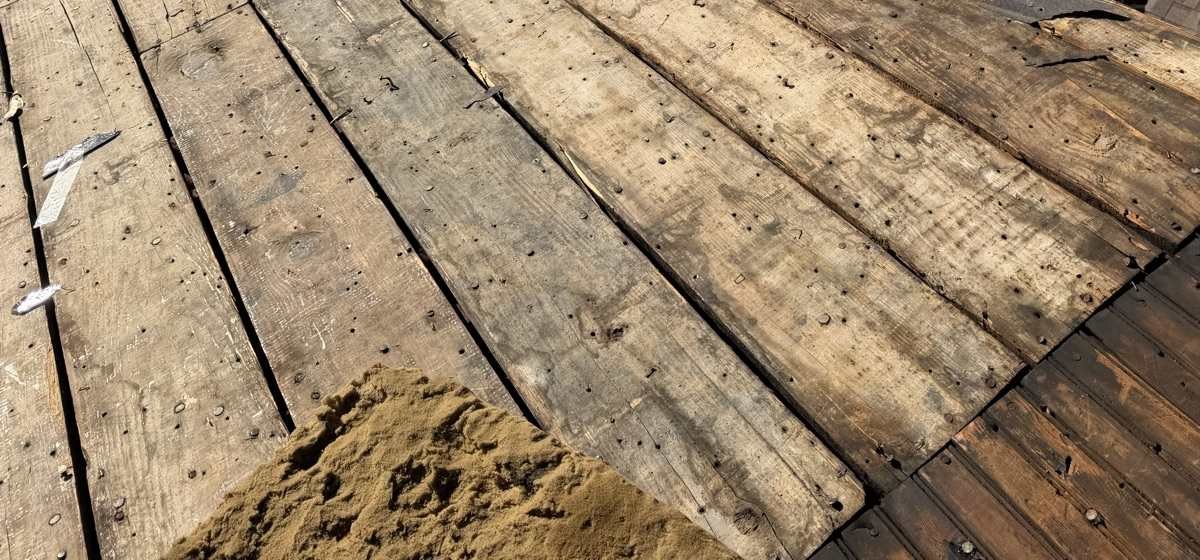
Under all of that is the decking, and on a house built in the first postwar wave the decking is very often planks with gaps between them rather than sheet material. Planks are not a defect. Plenty of them are sound after seventy years. But they are the part of the job that cannot be priced from the ground, they are what determines whether your job needs a permit at all, and they are the reason an honest number moves after the tear off.
Both of those are their own sheets: what is under your shingles and measuring a roof honestly.
The scope
Roofing, gutters and downspouts. Nothing else.
Keys Roofing does three things and turns down the rest. There is no siding division, no window division and no commercial arm. Shingles are Atlas and Malarkey.
- Replacement
- Full tear off to the deck, decking replaced where it has gone soft, then underlayment, ice and water membrane at the vulnerable details, valley metal, flashings, field and ridge.
- Repair
- Pipe boots, step and counterflashing, valley metal, nail pops, storm damaged sections, and the specific detail that is leaking rather than the whole plane.
- Inspection
- Photographs, measurements and a written scope you keep, whether or not Keys does the work.
- Gutter
- Seamless gutter formed on site to the length of the run, sized to the plan area of the roof feeding it rather than to what is on the truck, hung on hidden hangers, plus guards, realignment and repair.
- Drainage
- Downspouts, extensions, reroutes and underground carry away from the foundation. Unusual for a roofing company, and on a house with a finished lower level it is the part that decides whether a well built roof protects the house or quietly undermines it.
What Keys does not do is a shorter list: no representation on an insurance claim, nothing outside roofing and drainage, and no price given before somebody has been on the roof.
A point of honesty
Why there is no ranking of Creve Coeur roofers on this site
A page like this one is expected to end with a numbered list of the best roofers in town. This one does not, and the reason is worth stating plainly.
The unflattering paragraph
Pull every rated roofing business with a registered address across this metro and sort by municipality, and the count for Creve Coeur is zero. Chesterfield has twenty three. Kirkwood has twelve. Creve Coeur has none, and neither does Ladue. Ranking anybody as a Creve Coeur roofer by address would therefore mean ranking companies that are not here.
It gets worse if you try to fill the gap. The nearest thing to a local roofing category in that data is gutter cleaning, and in this market gutter cleaning firms are largely pressure washers and window cleaners. Sorting them into a roofing list and publishing it as local expertise has already been done by other people, and it produced a list that was wrong in a way no reader could see.
So this site publishes no ranking. It is also worth saying, since we are being direct, that Keys Roofing is not registered in Creve Coeur either. Keys works here. Keys is not from here. Any page that implies otherwise about anybody is telling you where a truck parks and calling it local knowledge.
The more useful question is not where a company is filed but who is physically on your roof on the day, whether that crew is employed or subcontracted, and whether the person who sold you the job will be there. That is sheet ten.
The file
Ten sheets, each answering one question properly
Every one of these exists because a homeowner in this part of the county actually asks it. They are as long as the question deserves and no longer.
Sheet 02
How much water your roof collectsThe arithmetic of a catchment, done in the open. One inch of rain on an ordinary Creve Coeur footprint, in gallons and in tons.
Sheet 03
What the trees put in the gutterOak and hickory canopy is why people live here. It is also an abrasive, a dam and a compost heap sitting directly above the drainage.
Sheet 04
Measuring a roof honestlySquares, pitch multipliers and waste factors, and why a price quoted from the driveway is a guess wearing a suit.
Sheet 05
What is under your shinglesPlank decking, spaced sheathing and early sheet goods. The layer nobody prices accurately and the one that decides whether you need a permit.
Sheet 06
Ventilation and the atticExhaust without intake does nothing. Mixed exhaust types do worse than nothing. What a big attic actually needs.
Sheet 07
Permits and the cityCreve Coeur runs its own building department, the county baseline sits underneath it, and Missouri issues no roofing licence at all.
Sheet 08
The hail record and a creditWhat NOAA, the National Weather Service, FEMA and the Missouri DCI actually published, and one Missouri tax credit that expires in 2026.
Sheet 09
The claim stays yoursRSMo 407.725, what a roofer may not do, what a public adjuster is, and the matching law Missouri does not have.
Sheet 10
Who is actually on your roofThe crew, the subcontract, the salesman on commission, and why a registered business address tells you almost nothing.
Sheet 11
The day of the workWhat Keys does, what Keys declines, and hour by hour what a tear off and rebuild looks like from your driveway.
Questions
Asked often enough to answer here
Do I need a permit to replace a roof in Creve Coeur?
Creve Coeur is an incorporated city with its own building department, so the city rule governs and you or your contractor should confirm it with the city before the dumpster arrives. The St. Louis County baseline underneath it is that a like for like asphalt replacement on a slope of 4:12 or steeper needs no permit, while a shallower slope does, a change of roofing material does, and replacing more than a quarter of the decking does.
Does Missouri license roofing contractors?
No. Missouri has no state roofing licence. Bills to create one were filed in 2016, 2019 and 2021 and all three failed, so there is no state number to ask for. Registration and licensing are municipal, which means the requirement can change when you cross a street.
Why does my gutter overflow when it was cleaned in the spring?
Because overflow is usually a capacity problem that gets diagnosed as a debris problem. A gutter is sized to the plan area of the roof feeding it and to the number of outlets draining it. If either of those was decided by habit rather than by arithmetic, the gutter will overshoot in a hard storm whether or not it is clean.
Is there a roofing company based in Creve Coeur?
Not in the rated business data for this metro. Zero roofing contractors carry a registered Creve Coeur address, which is a fact about where fleets and material yards can afford to sit, not a fact about who works on roofs here. It is also the reason this site publishes no ranking of local roofers.
Can Keys handle the insurance side of a storm claim?
No, and no roofing contractor in Missouri may, because RSMo 407.725 bars a contractor from representing or negotiating on a property owner's insurance claim. What Keys does is photograph and measure the roof, put the scope in writing, and attend on site as the contractor. The claim itself stays yours.