Plan area
The only area the sky cares about
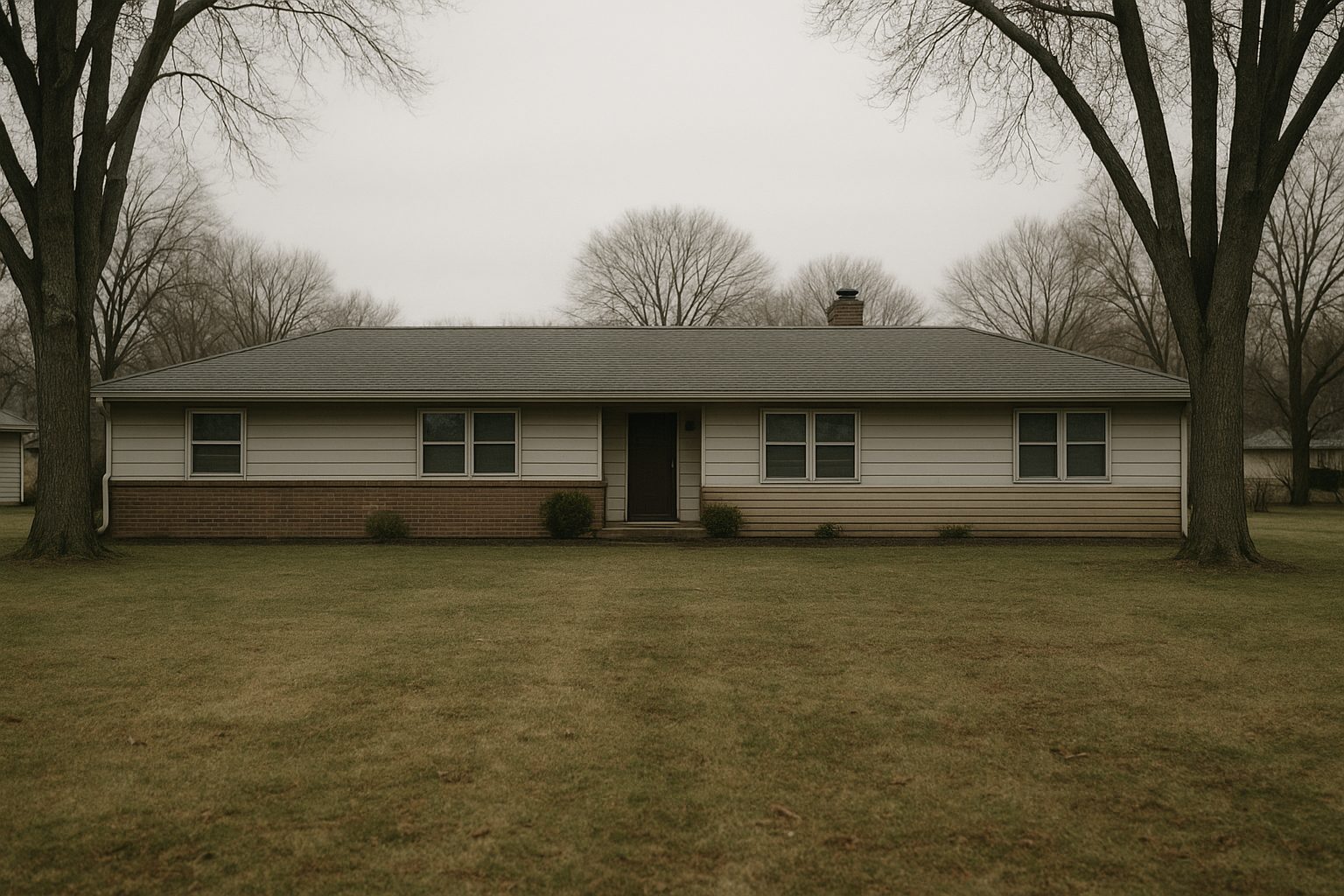
A roof collects rain according to its plan area: the shape you would see looking straight down at the house from directly above, measured flat. Rain falls vertically. It does not fall perpendicular to your roof plane, so the extra material you buy because of the slope collects no extra water.
That single sentence resolves most of the confusion about gutter sizing, and it is why a gutter quote based on how many squares of shingle went on the roof is starting from the wrong figure.
Reckoning 01 · one inch of rain on 2,600 square feet
At roughly 8.34 pounds per US gallon that is a little over six and a half tons of water leaving one ordinary house in one ordinary inch of rain. Nothing about this arithmetic is specific to Creve Coeur. What is specific to Creve Coeur is that footprints here are large, so the number starts high.
Gallons shed per inch of rainfall, by plan area
Multiply any of those by the depth of the storm. An inch and a half on a 2,600 square foot footprint is 2,431 gallons. In a thunderstorm that delivers it in forty minutes, all of it has to be through your downspouts and away from the house inside forty minutes, or it goes somewhere you did not choose.
Pitch
What the slope does and does not change
Pitch changes two things: the surface area you have to cover, and the speed at which water arrives at the eave. It changes nothing at all about the volume.
The multiplier is simple geometry. For a rise of R over a run of 12, the surface area is the plan area times the square root of one plus R over 12 squared. In practice:
- A 4:12 roof has 1.054 times the plan area in surface.
- A 6:12 roof, 1.118 times.
- An 8:12 roof, 1.202 times.
- A 10:12 roof, 1.302 times.
- A 12:12 roof, 1.414 times, which is the square root of two, because at 12:12 the slope is exactly 45 degrees.
So a 2,600 square foot footprint at 8:12 needs about 3,125 square feet of shingle, or 31.3 squares before waste. That is a materials fact and a labour fact. It is not a drainage fact. The gutter on that house still has 2,600 square feet pouring into it.
What the 8:12 does do is deliver that water fast. Velocity at the eave is why steep roofs overshoot their gutters, why the classic fix of adding a gutter apron or a deeper trough sometimes works when cleaning did not, and why two identical gutter runs on the same street can behave completely differently.
Outlets
The number that is almost never checked
Capacity is not just the cross section of the trough. It is the number and size of the outlets draining it, and where they sit along the run. A gutter is a holding channel, not a pipe. If the outlets cannot pass water as fast as the roof delivers it, the trough fills and then it spills, and it spills at the low point, which is wherever the ground happens to be worst.
Reckoning 02 · one run, two downspouts
Whether a given downspout section can move 405 gallons inside the duration of the storm is a question with a real answer, and roof drainage sizing tables exist to answer it. A contractor who has never opened one is sizing by habit, and habit on this street was set by the smaller houses that used to be on it.
Three practical consequences follow. Long runs need more outlets, not just bigger trough. A corner that collects two planes needs its own outlet rather than being asked to push water sideways around a mitre. And an outlet dropping into an undersized elbow at the top of a downspout throttles the whole run no matter how generous the gutter is.
The misdiagnosis
Why it gets blamed on the leaves
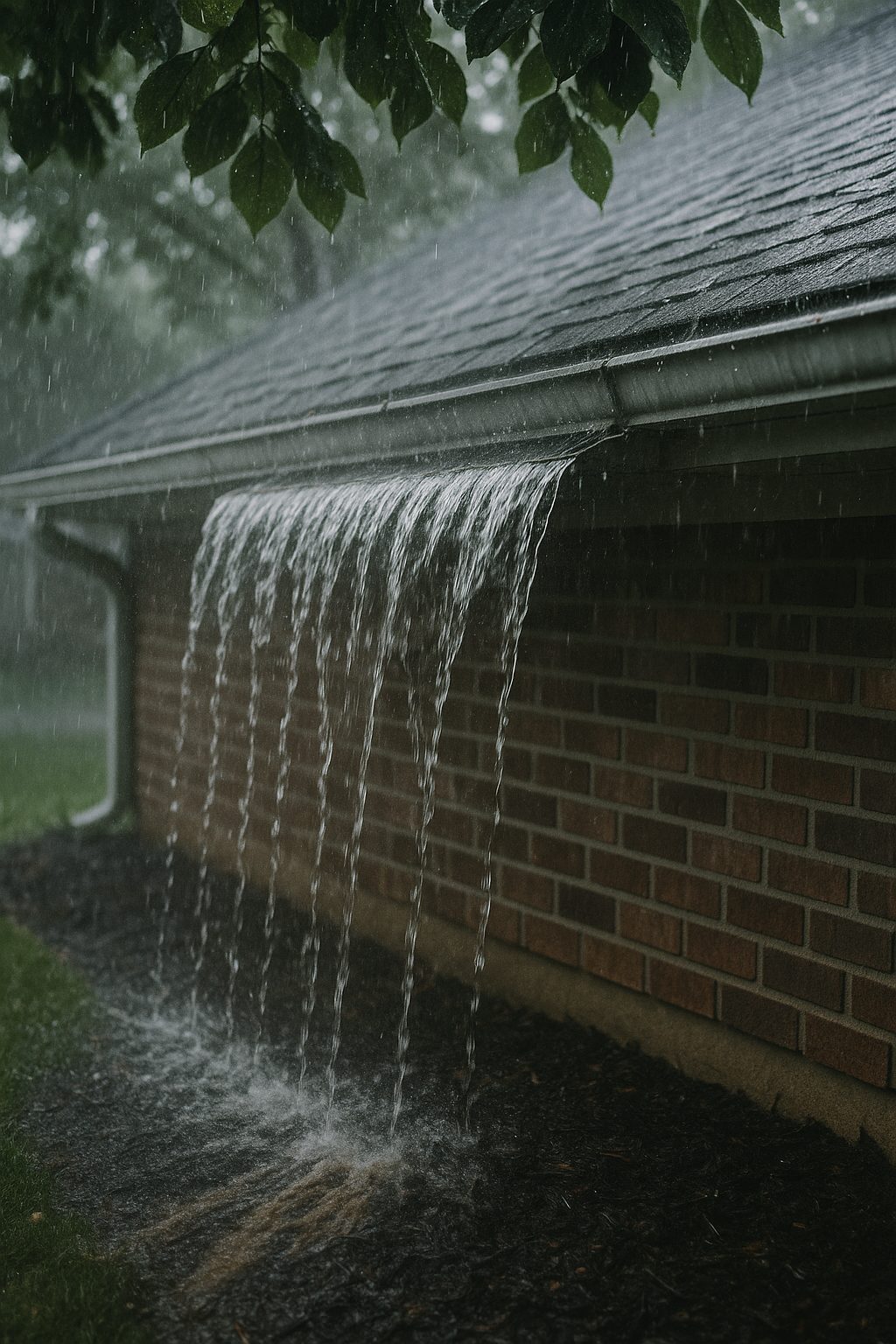
Here is the sequence, and it plays out on this side of the county every spring. A gutter overshoots in a heavy storm. Water sheets off the front lip onto the mulch bed, which erodes, and into the ground within three feet of the wall. The homeowner calls someone, who finds debris in the gutter, because on a lot with oak and hickory there is always debris in the gutter. The gutter is cleaned. The bill is small. Everybody is satisfied.
Next storm, same thing. Now the homeowner is told they need guards. Guards go on. Next storm, same thing, because the problem was never the debris.
The tell is simple and free to check. If the gutter overshoots in a hard storm and drips normally in a light one, and if the water is going over the front lip in a sheet rather than backing up behind the gutter, you are looking at a capacity or velocity problem and not a blockage. A blocked gutter overflows in light rain too.
The unflattering paragraph
Cleaning is cheap, quick and easy to sell. Resizing a run, adding outlets, correcting pitch or fitting a deeper trough is none of those things, and the company that told you it was leaves was not necessarily lying. It is simply the first answer, it is sometimes correct, and almost nobody goes back to check whether it worked.
What to do with this
Three questions worth asking out loud
None of these require you to know anything about roofing. They only require an answer.
- What is the plan area of the roof feeding this gutter run? If the answer is a shrug or a number in squares of shingle, the sizing has not been calculated.
- How many outlets are on this run and why that many? There should be a reason, and the reason should relate to the first answer.
- Where does the water go after the downspout? An extension that ends two feet from the wall on a lot that grades back toward the house has moved the problem eighteen inches.
If you want somebody to work through those three on your own roof, that is what the form below is for, or use (314) 220-2333. Related sheets: what the trees put in the gutter and measuring a roof honestly.